How Often Should a Small Business Post on Social Media (And Why the Number Is Not the Problem)
If you have ever opened your business page, stared at the empty post box, and closed it again because you were not sure whether posting twice in one day would annoy people, this is the answer you were looking for.
Most owners think the hard part of social media is deciding what to post. It is not. The hard part is deciding how much is too much, and almost everyone lands on a number far lower than the one that works.
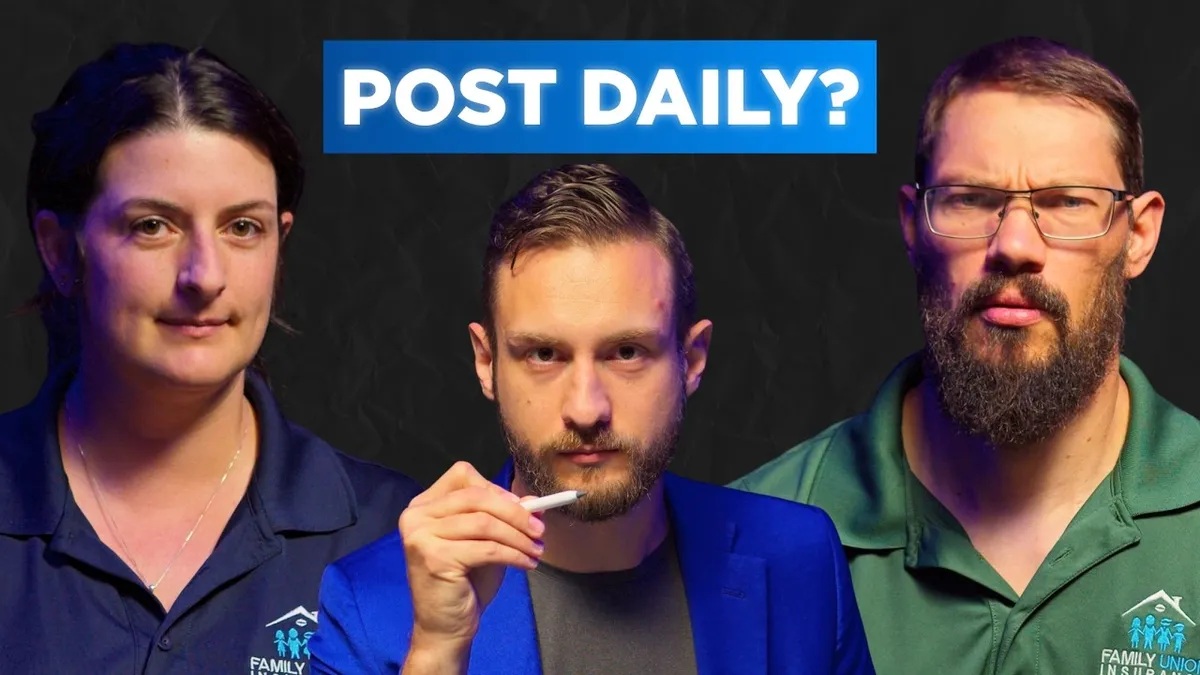
I sat down with David and Kim Ladish, who recently bought Family Union Insurance, an independent brokerage in the Kansas City area. David spent six years working there before buying it. Kim came in as the marketing department, which is to say Kim came in as one person, part time, with two home-schooled kids and no background in marketing.
They arrived with a written list of questions. Most owners are too embarrassed to ask them out loud.
The Broken Belief: Posting Daily Makes You Look Spammy
Kim asked it first. When does it get to be almost spammy, and start hurting our credibility?
Then she made her case. We are not selling lollipops. We are selling insurance, and insurance is inherently stressful to people.
That belief is the most common brake on small business social media, and it rests on an assumption that stopped being true years ago: that your audience sees everything you post, in order, as a feed.
Nothing is chronological anymore. A video post reaches a substantially new slice of people each time it goes out. The person who saw Tuesday's post is frequently not the person who sees Wednesday's. Posting three times in one day does not stack three impressions on one viewer. It usually finds three different rooms.
So the fear of annoying your audience with volume is mostly a fear of a feed that no longer exists.
The Reframe: Spammy Is a Ratio, Not a Frequency
Here is the part that actually answers the question.
Volume is not what makes content feel spammy. The ratio is.
You read as spam when you are always asking and never giving. Post a discount, a promotion, a call us today, and another call us today, and four posts is already too many. Post something that genuinely helps someone protect their house, their car, or their business, and nobody is counting.
Ask yourself who gets bored of being helped. If somebody unfollows you for consistently making their life easier, one of two facts is true. Either they were never going to buy from you, or they are not your customer. Both are worth learning early.
That reframe changes the question entirely. It is no longer how many posts before I am annoying. It is how many of my posts earn their place.
The Tactical Breakdown: Two Lanes and a Ramp
Knowing the principle does not put anything on the calendar. Here is the structure we built, and it generalizes past insurance.
Stop thinking in platforms. Start thinking in lanes.
David and Kim were treating five or six platforms as five or six separate jobs. That is how a part-time marketing department drowns. We collapsed it into two.
The professional lane is LinkedIn and the Google Business Profile. That is where David is the expert, where longer articles live, and where business owners are actually looking. The family lane is Facebook, Instagram, YouTube Shorts, and TikTok. That one is Kim's, and for a family-run brokerage it has the higher ceiling.
One lane per person. Nobody is managing six accounts.
Replace the number with a ramp.
When Kim asked how often, the honest answer was five times a week. She reminded me that she home schools two children. Fair.
So the plan was not a lower number. The plan was a ramp to the same number. Three posts a week to start, working up to five by day ninety. The target does not move. The on-ramp does.
A text post counts as a post.
This is the detail that made five feel possible. Two videos, one informational post, two text posts. That is five, and it is far smaller than five videos a week, which is what most owners hear and quietly decide is impossible.
Then fire before you aim.
Ready, fire, aim. Publish across everything, gather the feedback, and build a winners list from what actually landed. The feedback is not only the analytics. It is also the person at church or at a networking event who says they saw your video, never liked it, never commented, and remembered it anyway.
You cannot plan your way to that list. You can only discover it.
The Tool Mistake That Costs the Most Time
Kim was editing her videos in Canva. Canva is excellent, and it is a graphic design tool. It is built for flyers, thumbnails, and printed material. Cutting a video in it takes roughly three times the work it should.
CapCut, or Instagram's own editing tools, do the same job in a fraction of the time, and Instagram pushes straight through to Facebook. That removes one step from the process permanently, every week, forever.
The tool you learned first is rarely the tool the job needs.
The Message Problem Underneath All of It
Their website said save, save, save. They inherited that message from the previous owner, and it had quietly trained their own clients to see them as a price rather than a person.
But price is not what David does differently. What David does differently is take your call before you file a claim, because once you call the carrier directly you have either filed or you have not. He helps you make that decision.
No price comparison captures that, and it had never been said out loud on a single channel they own.
Most businesses have a version of this. The real differentiator is usually something the owner does instinctively and has never thought to say.
Why I See This Pattern Every Time
I run JT VSUALS, where we build content systems for founders, coaches, and local businesses. The Ladish situation is not unusual. It is the norm.
Someone competent buys or inherits a business, discovers the marketing was never systematized, and freezes at the exact question Kim asked. The freeze is not laziness and it is not a shortage of ideas. It is the absence of a frame that makes the volume feel survivable.
Give someone two lanes, a ramp, and permission for a text post to count, and the calendar fills itself.
Frequently Asked Strategic Questions
How often should a small business post on social media?
Aim for five times a week. If that is not survivable today, ramp to it: three a week now, five by day ninety. Mixing formats is what makes the number realistic, because a text post counts.
Will posting every day make my business look spammy?
Only if you are always asking. Volume is not what reads as spam, the ask-to-value ratio is. Helpful posts do not accumulate into annoyance.
Should I post on my personal profile or my business page?
Both, and they do different work. The business page establishes the organization. The personal profile is where people follow a human, and for a family-run business it often builds faster.
What should I post about when my industry seems boring?
Every specific problem you solve for someone is a post. Insurance is not boring to the person whose claim just got denied. Work backwards from the questions you already answer on the phone.
Which platform should a local business start with?
Start where your customers already are, and keep the Google Business Profile active regardless. For local businesses, reviews and local search drive discovery more reliably than any feed.
If You Want to See It Built
We built this plan live, on camera, with David and Kim in the room asking their real questions. Watch it here.
- Jared Taylor
